
Feature Rich Vibration Data Collection
BroadVibra software is installed inside Broadsens's wireless gateway, and can be accessed with web browsers such as Chrome, Firefox or Edge from computers through network. There is no subscription fee for the software. The software comes with life-time license and 1-year free upgrade. The software controls data collection of wireless vibration and temperature sensors, or other sensors such as wireless IMU, optical rotation speeds sensors, save data to the database, review the history data, export data, and send data to clouds based on user's request. BroadVibra software can be used with Broadsens's server software BroadView to provide aggregated monitoring of multiple edge-computing gateways and sensors.
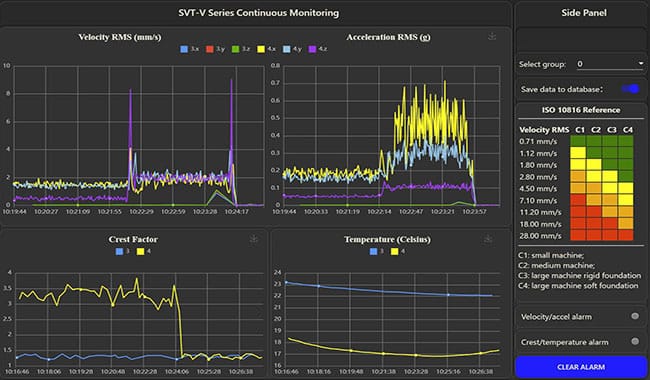
Real-time vibration monitoring ability
With SVT-V series wireless vibration sensors, the BroadVibra software monitors the vibration velocity rms, acceleration rms, crest factor and temperature in real time. If any one of the acceleration parameters exceeds a user-defined threshold, or lower than a bound, then the real-time wireless vibration sensor can detect it in less than 0.5 second typically. This is a truly unique feature of Broadsens's SVT-V series wireless vibration sensors. The real-time vibration monitoring ability is extremely useful to detect accidents such as sudden impacts or operator errors. Sudden events can not be predicted with artificial intelligence (AI) algorithms and account for more than 15% machine failures. They should be monitored by SVT-V series true real-time vibration sensors.

Advanced DAQ modes
BroadVibra vibration analysis software provides multiple modes of data acquisition for SVT-A series wireless vibration sensors: including real-time, batch, single DAQ, multi DAQ, single FFT, live FFT and trigger mode. Sampling rates in real-time mode range from 2Hz to 200Hz; sampling rates in batch, single DAQ, multi DAQ, FFT, live FFT and trigger mode range from 400Hz up to 25.6kHz. Real-time, batch, multi DAQ and live FFT mode provide unlimited data acquisition points. In single DAQ, single FFT and trigger mode, sampling points range from 2,048 up to 16,384. All DAQ modes support synchronization among sensors in the same group, so that sensors can take data at the same time. Acceleration range is also adjustable from 2g up to 64g (depending on sensor type).

Database history data review
Integrated time-series database supports long-term vibration data review and analysis. SVT-A series sensor and SVT-V series sensor data can be reviewed and plotted easily with the software. The software supports latest data query or allows user to enter a date and time to review the data in a specific time period. The software allows flexible data points selection. Small data points query allows fast history data review, and large data points query allows user to check data in a long time span. Data curve can be zoomed in for detailed view. Raw acceleration data and temperature data can be exported to CSV format file for further analysis.

Vibration trend analysis
Vibration trend analysis is very useful to help users identify machine problems quickly when time goes by. This is especially useful for applications where the sensors are permanently mounted in a hazardous location. Currently, there are seven parameters provided in vibration trend analysis:
• RMS (root mean square) • True peak(maximum absolute value)
• Crest factor • Kurtosis
• Skewness • Mean
• Standard deviation • Peak-peak (envelope)

FFT Analysis & Filtering
FFT analysis can be carried at each vibration sensor. In the figure, the top chart is the FFT waveform, and the bottom chart is the corresponding time-domain waveform. The waveforms can be zoomed in easily for detailed view. FFT result and time-domain data can be downloaded from the interface. High pass, low pass and band pass filters can be added for the time domain data and FFT analysis. BroadVibra provides the best filtering abilities in the vibration analysis, in which users can adjust the cutoff frequency freely without any limitation. Filtering order can be adjusted too.
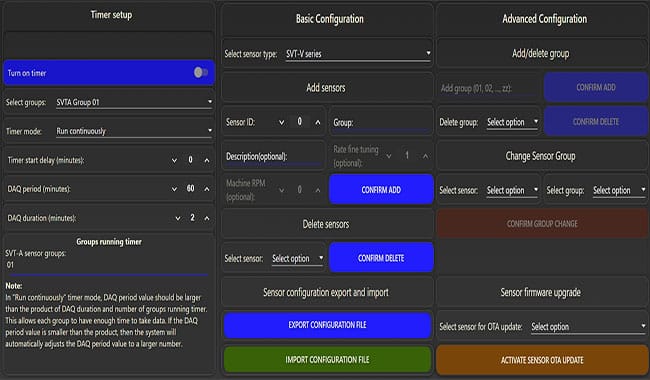
Automatic DAQ and analysis
Timer can be set up for each group of SVT-A series wireless vibration & temperature sensors for automatic DAQ (timer is not needed for SVT-V series sensors, since everything is automatic for SVT-V series sensors for simple usage). Since Broadsens ultra-low power wireless vibration sensors have the highest battery efficiency in the industry, the minimum DAQ period (interval) can be as low as every 3 minutes (can be customized down to every 1 minute). This simplifies user's work and makes the machine condition monitoring an easy work. Vibration analysis such as trend monitoring can also be automized by user-specified interval.

Alarm and email notification
It is easy to set up vibration alarms for SVT-A series sensors and SVT-V series sensors. For SVT-A series sensors, alarm thresholds can be set up for each group differently. The thresholds include acceleration levels for x, y & z axes and temperature. For SVT-V series sensors, each sensor can have different alarm range including vibration velocity rms, acceleration rms, crest factor and temperature. Velocity rms and acceleration rms have upper and lower bounds, which can not only monitor machine defects, but also tell the machine shutting down when the vibration level is low. Alarm LED will turn into red color when the vibration exceeds a predefined level. Email notification can be enabled and disabled by togging a switch easily. The alarm can be sent to multiple recipients with detailed alarm information including alarm sensor id and measurements.

MQTT data upload and control
Raw data can be transferred to user’s server or clouds in real time via MQTT protocol. Broadsens also provides standard server software BroadView to monitor sensors from multiple gateways. Each gateway can be assigned a unique name. There is no limit on how many gateways a factory uses, so that tens of thousands of gateways and unlimited number of sensors can be used. To save network bandwidth, the MQTT raw data output can be turned off. One can select only transmitting the vibration and temperature alarm, and analysis result to the server/cloud instead. Each gateway also allows remote control of the DAQ from a server or clouds. Broadsens provides standard MQTT protocol, data format and examples to help users set up the MQTT communication.